

Half of consumers use AI to research products before they buy. Less than 1% of traffic gets tagged as AI-referred in analytics. That gap isn’t a measurement error. It’s a structural one, and it has real consequences for how e-commerce teams allocate budget, evaluate channels, and think about what “organic” actually means in 2026.
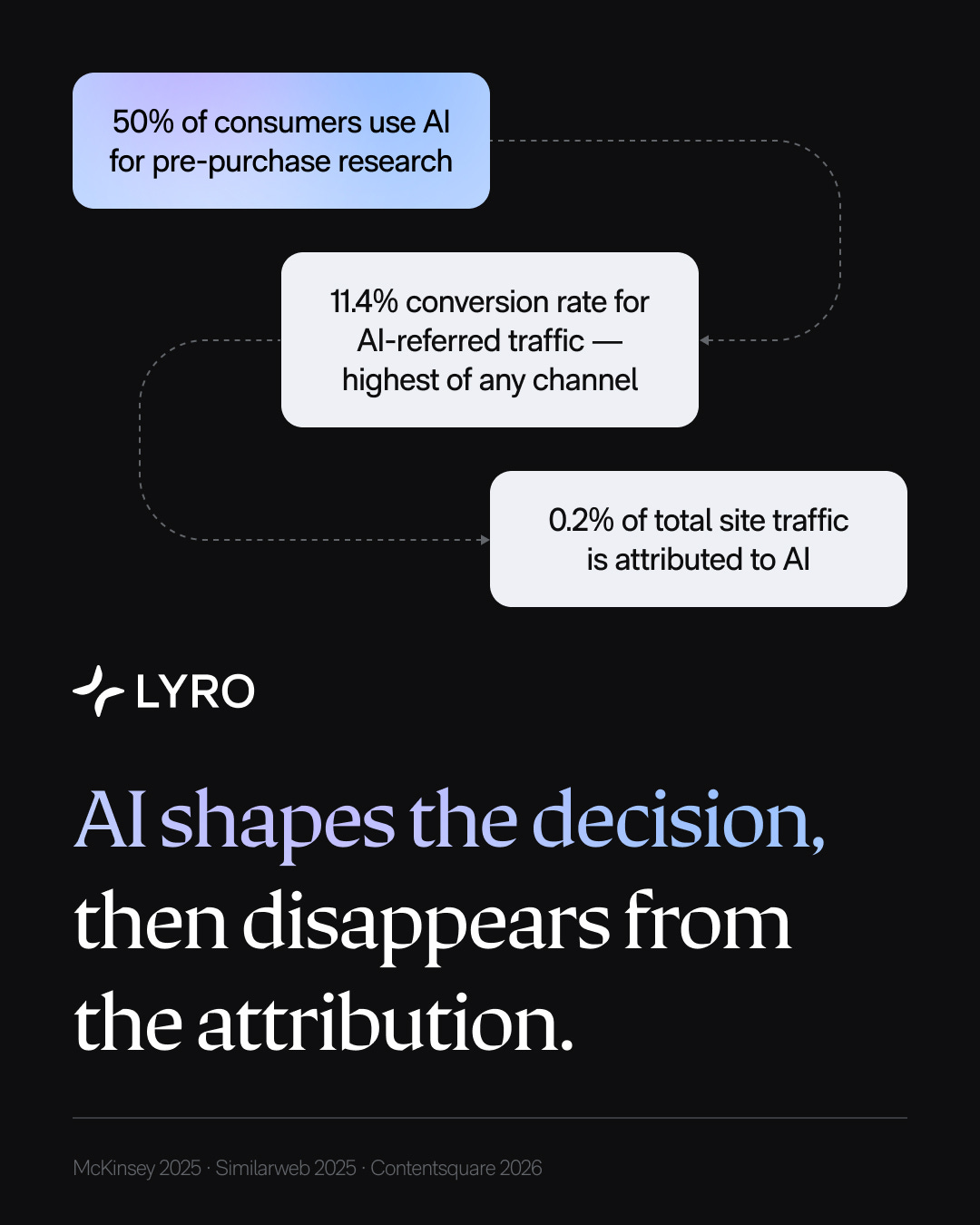
Here’s how the blind spot works. Someone asks ChatGPT which espresso machine to buy under $400. ChatGPT gives them three names, maybe a sentence of reasoning on each. They don’t click a link. They open a new tab, search one of those brand names directly, and convert. That purchase shows up as branded search or direct traffic. The AI that initiated the entire journey gets no credit.
Call this the “dark AI” problem. It’s bigger than it looks. McKinsey’s consumer survey found that 50% of shoppers now intentionally seek out AI-powered search, and 44% consider it their primary information source. The Eight Oh Two AI & Search Behavior Study puts the share of U.S. AI users who start product searches with AI rather than Google at 37%. Both figures are attitudinal, self-reported behavior from surveys. Then there’s the supply-side number from Contentsquare, which actually measures traffic: AI-referred sessions account for 0.2% of total website visits.
The gap between 37–50% and 0.2% is the dark AI effect in numbers.
The Conversion Signal Is Real, but Complicated
The sessions that do get tagged as AI-referred convert well. Similarweb’s aggregate data across U.S. retail put ChatGPT referral conversion at 11.4% in June 2025—the highest of any channel, ahead of direct (10.2%), paid search (9.3%), and organic (5.3%). Individual case studies report even stronger numbers: one e-commerce brand saw 4.2% conversion from ChatGPT traffic against a 2% baseline; a B2B SaaS company found ChatGPT homepage visitors converting at 8.6% versus 2.1% for Google organic.
The most rigorous academic study to date complicates this picture. Researchers analyzing first-party data from 973 e-commerce websites representing $20 billion in combined revenue found that ChatGPT referrals actually converted worse than most traditional channels after controlling for site effects and data sparsity, with affiliate links outperforming ChatGPT referrals by 86% and organic search outperforming by roughly 13%. The authors noted that conversion rates were improving steadily over the study period and that the gap with traditional channels was narrowing, but the headline finding runs directly against the case studies.
A mid-scale study of 94 e-commerce stores over 12 months lands somewhere in between: ChatGPT traffic converted 31% better than non-branded organic search, but average order value was 14.3% lower, reducing the net revenue-per-session advantage to just 10.3%. Not nothing, but not the 2–4× lift the case studies suggest.
The likely explanation for the spread: methodology. Aggregate panel data and self-selected case studies probably skew toward sites and categories where ChatGPT performs well. Controlled regression on large datasets catches the average, including the many sites where AI referrals are sparse and noisy. Both can be true at once.
What Dark AI Means for Attribution Models
The more important point is that last-click attribution systematically undercounts AI’s influence regardless of which conversion rate figure you believe.
TollBit’s State of the Bots report adds a revealing publisher-side data point: click-through rates from AI applications dropped nearly 3× over the course of 2025, from 0.8% in Q2 to 0.27% by year-end. Even sites with direct AI licensing deals saw CTR fall over 6.5×.
AI platforms are scraping more content and sending fewer clicks. The summary is increasingly substituting for the visit, especially in categories like shopping and entertainment where answering the question doesn’t require the user to go anywhere.
Google, by comparison, still delivers over 678× more human visitors per referral than AI applications. The channel hasn’t flipped. But the direction is clear, and the brands not accounting for it are making media mix decisions on incomplete data.
The practical response is to augment last-click measurement, not abandon it. Attribution models that track assisted conversions, brand search lift, and direct traffic trends alongside referred sessions will catch more of what AI is actually doing. For brands with the data infrastructure, controlled experiments that measure brand search volume after AI visibility changes can help isolate the effect directly. It might also be time to whip out that “how did you learn about us?” quick form.
AI shelf-readiness that enables brands to get visibility on “AI page one” is only half of the attribution problem in agentic funnels. The other half is what happens when the consumer isn’t the one clicking “buy.” That’s where we’re headed next.
Download the full AI in ecommerce report I based this post on here